Two spec sheets, one species, two very different products
Picture two lion’s mane extract quotes on your desk. Supplier A lists “30% polysaccharides”. Supplier B lists “20% beta-glucans” and costs more. On paper, A looks like the better deal.
It may not be. Those two numbers come from different tests that measure different things. A “polysaccharide” figure can include starch from the grain the mushroom was grown on. A beta-glucan figure from an enzymatic method counts only the compounds most buyers are actually paying for.
This guide explains what each number means, how each one is tested, and what to ask for before you sign a purchase order. If you’ve read our piece on why a 4:1 extract ratio measures yield, not potency, this is the next step: how to verify the chemistry itself.
What polysaccharides and beta-glucans actually are
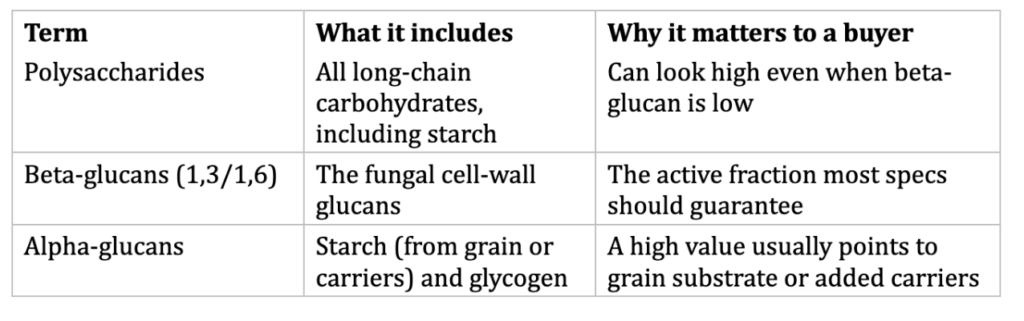
“Polysaccharide” is a broad chemical category: any long chain of sugar units. Starch, cellulose, chitin, pectin and beta-glucans are all polysaccharides. So a polysaccharide percentage tells you how much long-chain carbohydrate is present, not which kind.
Beta-glucans are one specific family inside that category. In mushrooms they are mainly 1,3-beta-glucans with 1,6 branches, and they are a major structural part of the fungal cell wall. They are the compounds most functional mushroom research focuses on, and the ones formulators usually want to standardize.
Alpha-glucans are the other glucose polymers you need to know about. In plants, the main one is starch. Fungi store energy as glycogen rather than starch, and mushroom fruiting bodies usually contain only a few percent of alpha-glucan at most. Cereal grains such as rice, oats and sorghum, by contrast, are mostly starch.
How each number is tested
The two figures come from tests with very different levels of specificity.
Total polysaccharides: the phenol-sulfuric acid method. This classic colorimetric assay was first published by Dubois and colleagues in 1956. Concentrated sulfuric acid breaks carbohydrates down and converts the sugars into furfural compounds. These react with phenol to form a color, which is read on a UV-visible spectrophotometer. That’s why many CoAs list the method simply as “UV”. A standard food-analysis lab manual notes that the method “detects virtually all classes of carbohydrates, including mono-, di-, oligo-, and polysaccharides” (Nielsen, 2010). It is quick and cheap. But it cannot tell a fungal beta-glucan from rice starch.
Beta-glucans: the enzymatic (Megazyme) method. In 2016, Barry McCleary and Anna Draga published a method in the Journal of AOAC International built specifically for mushrooms and mycelial products. It works in three steps:
Total glucan. The sample is partially hydrolyzed in strong sulfuric acid. Specific enzymes then break the remaining fragments down to glucose, which is measured.
Alpha-glucan. A separate portion is digested with enzymes that break down starch and glycogen, and the glucose released is measured.
Beta-glucan by difference. Total glucan minus alpha-glucan equals beta-glucan.
The method is sold as the Megazyme K-YBGL assay kit (“Yeast and Mushroom”). Independent research groups use it to report mushroom beta-glucan content. For example, Belobrajdic et al. (2024) used it in Food & Function to measure button and oyster mushrooms. Megazyme updated the kit effective October 1, 2025. The update adds alpha-amylase to the alpha-glucan enzyme mix and cuts the run time from about 7 hours to about 4.5. Ask your lab which protocol version it runs.
The practical point: a beta-glucan figure from this method has the starch subtracted out. A phenol-sulfuric polysaccharide figure does not.
Why starch inflates polysaccharide numbers
Many “mushroom” ingredients are mycelium grown on sterilized grain and then dried and milled together with that grain. The grain doesn’t disappear. It stays in the powder as starch, and a total-polysaccharide test counts it.
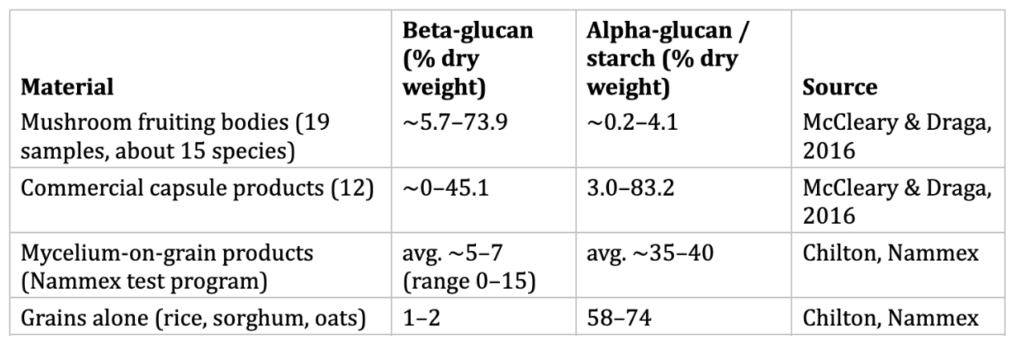
McCleary and Draga found that in mycelium products grown on grain, “the bulk of the starch in the grain remains intact and is by far the major glucan present in the final product.” In the most extreme product they tested, alpha-glucan made up 83.2% of the powder.
Now run those numbers through a phenol-sulfuric test. A mycelium-on-grain powder with 40% starch and 5% beta-glucan can easily report “40%+ polysaccharides”. A fruiting-body extract with 25% beta-glucan and almost no starch might report a lower polysaccharide figure, yet contain five times the beta-glucan.
That’s why polysaccharide percentages are not comparable across suppliers, and why the source material matters. We cover the biology in more depth in Fruiting Body vs. Mycelium: The Great Medicinal Mushroom Debate.
A real CoA, line by line
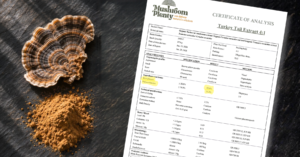
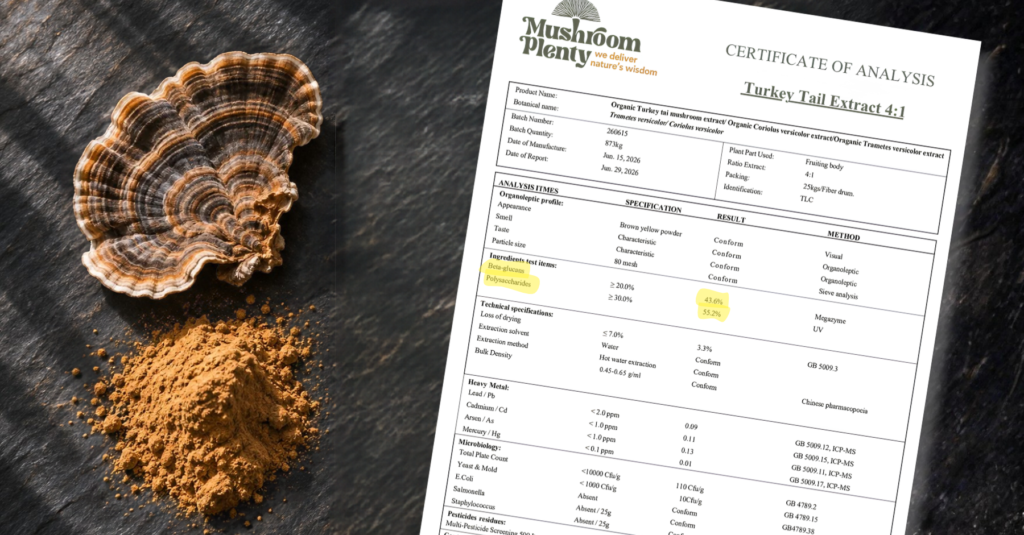
Here is how this looks on one of our own certificates, from a recent production lot of Turkey Tail Extract 4:1 (Trametes versicolor, lot 260615):
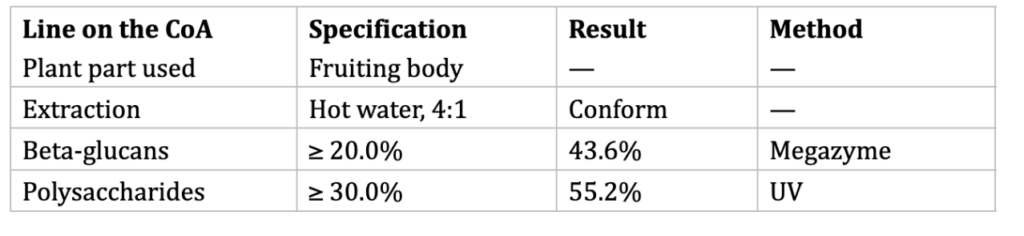
Three things to notice. First, the two numbers are reported side by side, each with its method named, so a buyer can see exactly what was measured. Second, the polysaccharide figure is higher than the beta-glucan figure. That is expected, because the UV test counts every carbohydrate, including the other polysaccharides and sugars in a hot-water extract. Third, the spec that matters for formulation is the beta-glucan minimum, guaranteed and measured by an enzymatic method.
How Mushroom Plenty reports actives
Our extracts are made from fruiting bodies by hot-water extraction, and every lot ships with a lot-specific Certificate of Analysis. Beta-glucans are measured with the Megazyme enzymatic method, and the method is named on the CoA next to the result, as in the Turkey Tail example above. On each product page you’ll find the extract ratio, the part used, mesh size and the guaranteed actives figure. If you need the alpha-glucan figure for a lot, ask and we’ll provide it.
If you’re comparing us with another supplier, send us both spec sheets. We’ll walk you through how the numbers were measured, so you’re comparing like with like.
Browse the specs: Lion’s Mane · Turkey Tail ·
See how we test: Quality & Sourcing
Ready to compare? Request a quote and a sample CoA
Frequently asked questions
Is a polysaccharide percentage useless? Not useless, just incomplete. It tells you how much total carbohydrate is present. Without a beta-glucan and alpha-glucan figure next to it, you can’t tell how much of it is starch.
What does “UV” mean on a CoA? It usually means a colorimetric test read on a UV-visible spectrophotometer, most often the phenol-sulfuric acid method for total carbohydrates. It’s a valid test for total polysaccharides, but it doesn’t separate beta-glucan from starch.
What is a good beta-glucan percentage for a mushroom extract? It depends on the species and the process. In McCleary and Draga’s tests, fruiting-body samples ranged from about 6% to 74% beta-glucan. Compare suppliers on the same species, tested by the same method.
Why does my COA show a higher number from one supplier than another? Often because they used different methods. A phenol-sulfuric polysaccharide result and an enzymatic beta-glucan result are not comparable, even for the same powder.
Does the Megazyme method detect starch? Yes. It measures alpha-glucan separately and subtracts it from total glucan, so starch is reported on its own line instead of being counted as beta-glucan.
Do mycelium products always have less beta-glucan? Not always, but products made from mycelium grown on grain tend to carry a lot of residual starch. In the published tests, these products had much lower beta-glucan and much higher alpha-glucan than pure fruiting bodies.
What should I put in my RFQ? Ask for a guaranteed minimum beta-glucan, the test method by name, the alpha-glucan figure, the source material, and a lot-specific CoA.
References
McCleary, B. V., & Draga, A. (2016). Measurement of β-glucan in mushrooms and mycelial products. Journal of AOAC International, 99(2), 364–373. PubMed 26957216
Megazyme. β-Glucan Assay Kit (Yeast and Mushroom), K-YBGL: product page and kit update effective October 1, 2025. megazyme.com
Belobrajdic, D. P., Brook, H., James-Martin, G., & Stonehouse, W. (2024). β-Glucan content and in vitro bile-acid binding capacity of Agaricus bisporus and Pleurotus spp. Food & Function, 15(19), 9880–9887. doi:10.1039/d4fo02416h
Nielsen, S. S. (2010). Phenol-sulfuric acid method for total carbohydrates. In Food Analysis Laboratory Manual. Springer. doi:10.1007/978-1-4419-1463-7_6
Dubois, M., Gilles, K. A., Hamilton, J. K., Rebers, P. A., & Smith, F. (1956). Colorimetric method for determination of sugars and related substances. Analytical Chemistry, 28(3), 350–356. doi:10.1021/ac60111a017
Chilton, J. Redefining Medicinal Mushrooms. Nammex analytical program overview (c. 2015), hosted by Megazyme. PDF
This article is for B2B ingredient buyers and is not medical advice.