4:1 tells you how the extract was made, not how potent it is. Verify the chemistry, not just the ratio.
One of the most frequently quoted yet least understood statements on a mushroom ingredient specification sheet is:
“4:1 hot-water extract.”
Many buyers assume the ratio reflects potency and do not investigate further.
However, the extraction ratio alone does not provide a complete picture.
It provides insight into the manufacturing process and helps formulators, brand owners, and purchasing teams feel assured that understanding the process builds trust in the extract’s quality, not just the ratio.
What does 4:1 actually mean?
A 4:1 extraction ratio means four kilograms of starting mushroom material yield one kilogram of native extract.
Technically, this is similar to a drug-extract ratio (DER): the amount of starting material relative to the extract obtained. The ratio should refer to the native extract before adding carriers or processing aids.
So, in its simplest form:
4 kg dried mushroom material = 1 kg native extract
Although this seems straightforward, buyers should still ask:
- Was the starting material a fruiting body, mycelium, or a combination?
- Was it grown on grain or another substrate?
- Is the ratio calculated before or after adding carriers?
- Was the entire extraction yield dried, or were selected fractions removed?
- Is 4:1 a fixed ratio or an approximate production range?
- What compounds are actually present in the finished powder?
The ratio reflects a manufacturing relationship, not a comprehensive chemical specification. Higher extraction ratios do not necessarily indicate superior extracts.
The market often portrays extraction ratios as a straightforward measure of potency:
4:1 is stronger than 2:1.
10:1 is stronger than 4:1.
20:1 must be better than all of them.
However, mushroom chemistry is more complex.
A higher ratio may reflect:
- A lower extraction yield
- More extensive filtration
- Removal of insoluble material
- Selective concentration of certain fractions
- Repeated extraction cycles
- A particular way of calculating the starting material
- Or, in some cases, an unsupported marketing claim
It does not indicate that all active compounds are concentrated equally.
A genuine 4:1 extract should not be assumed to have four times the bioactivity of the original mushroom powder.
Compounds vary in solubility, extraction efficiency, thermal stability, and molecular structure. Processing conditions affect both yield and the chemical profile of the final ingredient. Research shows that temperature, time, pressure, pH, and purification steps can significantly impact recovery and structure.
The key question is not “How high is the ratio?” but rather “What does the process recover, and what is present in the finished extract?” This shift in focus can help formulators and buyers feel more empowered to evaluate extract quality critically.
Is a 1:1 ingredient necessarily an unextracted powder? No, it is not.
“A product described as 1:1 may be an ordinary milled mushroom powder, or it may be an extracted preparation whose native dry-extract yield approaches the starting dry mass. The manufacturing record—not the ratio alone—must establish which one it is.”
For example, an extracted liquid can be concentrated and dried with soluble and suspended mushroom solids, resulting in a finished mass similar to the original input. While this product may be called an extract, its composition will differ significantly from that of a highly filtered extract.
Therefore, the term “extract” must be evaluated alongside:
- The extraction solvent
- The manufacturing process
- The native extraction ratio
- The use of carriers
- The analytical results
- The biological material used.
Why hot water?
Mushroom cell walls contain a complex matrix of chitin, glucans, proteins, and other structural components. Hot-water extraction is commonly used to release water-soluble and water-dispersible polysaccharide fractions from this matrix. It is particularly relevant to the recovery of mushroom polysaccharides, including certain beta-glucan fractions. However, even the term “water-soluble beta-glucans” requires further clarification. Mushrooms contain beta-glucans with different branching patterns, molecular weights, conformations, and solubility characteristics. Some fractions are readily extracted in hot water. Others may require alkaline, enzymatic, pressurized, or sequential extraction methods.
Hot water is a well-established extraction method, but it does not recover all beta-glucans or every relevant mushroom compound.
What about the other bioactives?
Not all mushroom compounds behave the same way during extraction.
Polysaccharides and beta-glucans
“Hot-water extraction is commonly used to solubilize or disperse selected polysaccharide fractions and separate them from part of the insoluble structural matrix.”
Extraction efficiency depends on:
- Species
- Raw-material quality
- Particle size
- Temperature
- Extraction time
- Water-to-material ratio
- Pressure
- pH
- Filtration and purification
Reishi triterpenoids
Many triterpenoids in Ganoderma species are more efficiently recovered with ethanol or hydroalcoholic extraction than with water alone. If a reishi ingredient is intended to provide both polysaccharide and triterpenoid fractions, a dual or sequential extraction process may be appropriate. However, “dual extracted” does not guarantee quality. The supplier must document solvents, ratios, processing conditions, residual-solvent compliance, and finished-product chemistry.
Lion’s Mane compounds
Lion’s Mane chemistry is often oversimplified. Hericenones have been reported principally from fruiting bodies, while erinacines, especially the better-characterized cyathane diterpenoids, are primarily associated with cultured mycelium.
. These are distinct compounds, and their presence cannot be assumed based solely on the label “Lion’s Mane extract.” An aqueous extract may contain valuable polysaccharides and other water-extractable compounds, but should not be described as a concentrated source of hericenones unless specifically tested. Modern analytical methods can distinguish and quantify these markers, though commercial specifications remain inconsistent.
Cordyceps compounds
Cordycepin and adenosine-related compounds can be recovered in aqueous systems, but their final concentrations depend on species, strain, biological material, cultivation method, processing conditions, and analytical methods. A high extraction ratio does not guarantee high cordycepin content.
What a credible hot-water extraction process may look like
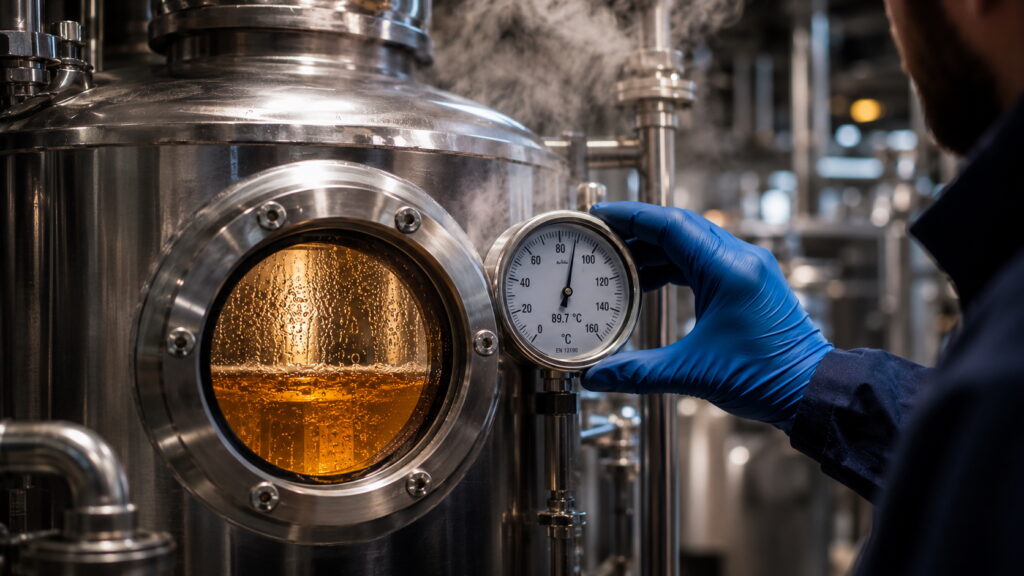
The precise process varies by species, facility, and target specification, but a typical industrial workflow may include:
- Raw-material identification and release testing
Authenticate the species and biological material before processing. - Milling
Reduce dried material to a controlled particle size to improve contact with the extraction medium. - Hot-water extraction
Combine mushroom material with purified water and extract under controlled temperature and time conditions. - Separation or filtration
Remove insoluble material as needed, depending on the desired extract profile. - Concentration
Concentrate the liquid extract, often under reduced pressure to minimize thermal exposure. - Drying
Use spray drying, vacuum drying, or freeze drying to convert the concentrate into powder. - Blending or standardization
Blend the dried extract for consistency. Declare any carriers or excipients used. - Finished-product testing
Evaluate the extract against identity, microbiological, chemical, physical, and contaminant specifications.
How buyers should verify a 4:1 claim
Recommended questions to ask:
1. What exactly is the starting material?
Request the scientific name and the biological material used:
- Fruiting body
- Mycelium
- Extracellular culture medium
- Myceliated grain
- A combination of materials
2. Is the 4:1 ratio calculated on the native extract?
Ask whether the stated ratio applies before or after the addition of:
- Maltodextrin, Starch, Dextrins, Silica, Other carriers or processing aids
Do not represent a product with significant carrier content as if the entire finished powder is a native 4:1 extract.
3. What analytical markers are tested?
At a minimum, depending on the species and product positioning, consider requesting:
- Beta-glucans
- Alpha-glucans or starch
- Total glucans
- Moisture
- Protein
- Species identity
- Relevant species-specific markers
- Heavy metals
- Pesticides
- Microbiology
- Residual solvents when applicable
Total polysaccharide testing alone does not substitute for beta-glucan testing. Depending on the method and sample preparation, the result may include multiple carbohydrate fractions, including alpha-glucans, starch-derived material, dextrins, other polysaccharides, and some carbohydrate-based carriers.
4. Is the extract standardized?
An extraction ratio and a standardized extract are not the same thing.
A 4:1 extract may vary from batch to batch unless blended or standardized to a defined analytical range.
For consistent formulation, measurable composition is usually more important than the ratio listed on the specification sheet.
The most useful check
Do not assume a 4:1 ratio yields four times the beta-glucan percentage of the starting mushroom. Depending on species, intended use, process, and risk assessment, the specification may include
- The starting material’s composition
- The native extraction yield
- The finished extract’s beta-glucan level
- The alpha-glucan or starch level
- The amount of carrier
- The mass-balance documentation
The data should present a clear and consistent narrative. For example, if a supplier claims a highly concentrated fruiting-body extract but reports A beta-glucan and alpha-glucan profile that is inconsistent with the declared starting material, carrier system, or extraction process, it should trigger further investigation.
Why this matters in formulation
A genuine 4:1 extraction ratio means that four units by mass of a defined starting material were used to produce one unit by mass of native extract. The moisture basis, starting material, extraction solvent, native yield, and presence of carriers must be stated for the number to be meaningful.
The ratio describes manufacturing yield or concentration by mass. It does not independently establish beta-glucan content, marker-compound concentration, purity, bioactivity, or clinical equivalence.
Extraction influences dose calculations but does not replace them.
A common mistake is equating raw-mushroom equivalence with clinical equivalence.
For example:
500 mg of a 4:1 extract may be described as having been produced from 2,000 mg of starting mushroom material.
This is a valid mass-equivalence calculation, provided the ratio is genuine.
However, this does not prove that the 500 mg extract contains the same complete chemical profile as 2,000 mg of whole mushroom powder. Nor does it prove equivalence to a clinical study unless the study used a comparable ingredient.
Therefore, statements like “4:1 is the ratio used in most clinical research” should be avoided unless supported for a specific species, ingredient, and clinical endpoint.
Mushroom studies have used whole powders, aqueous extracts, ethanol extracts, proprietary standardized extracts, mycelial preparations, isolated polysaccharides, and fermented materials.
There is no single universal extraction ratio behind the entire evidence base.
This distinction separates simply purchasing a mushroom ingredient from selecting one that is technically defensible.
By Sam Dahan
Founder of Mushroom Plenty