Over the last 12–18 months, mushroom coffee has gone from “quirky wellness aisle curiosity” to a full-blown attention-economy category. New brands and influencer promos are nonstop. The claims have escalated into an arms race: focus, gut health, immunity, calm energy, better sleep, “no crash”-sometimes all in the same ad.
When a category expands this fast, the real question becomes:
Is this durable consumer demand or a hype loop?
My honest answer: both.
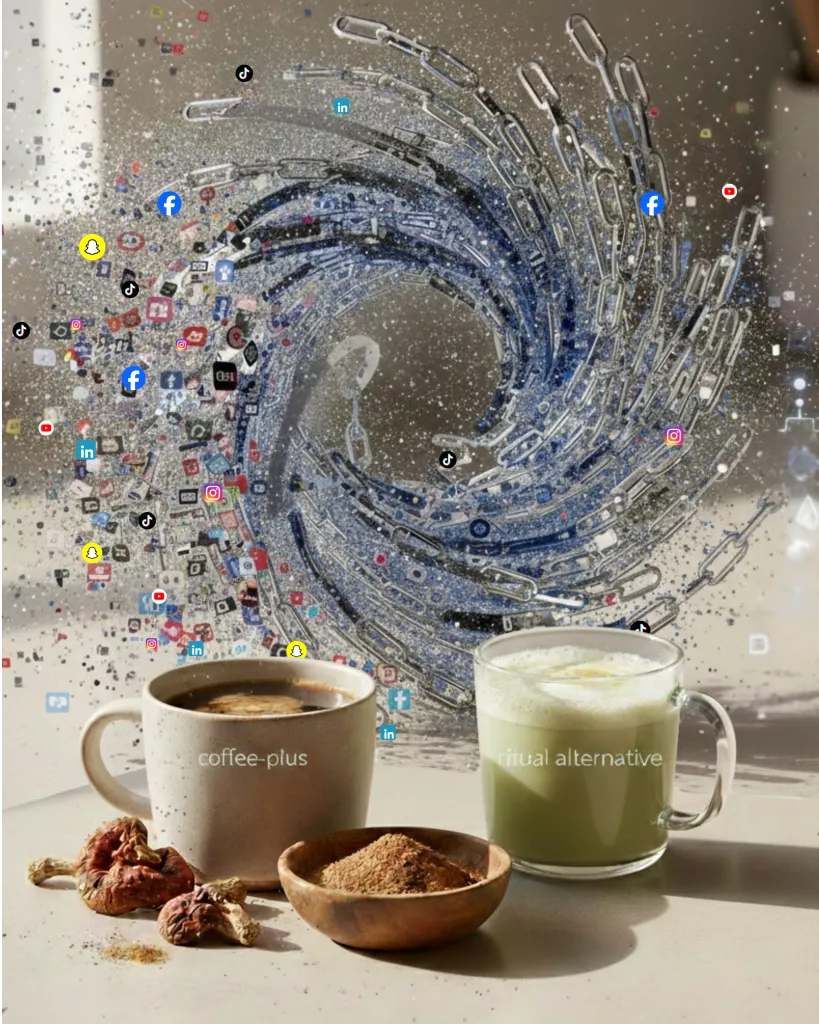
There is measurable consumer behavior driving this market; however, these behaviors are being amplified and, at times, distorted by an affiliate-based growth strategy that rewards persuasive tactics rather than verifiable evidence. This dynamic, which I refer to as the “Link Controversy,” is fueled by the use of affiliate links, social shopping links, expert endorsements, and newsletters, along with the incentives that accompany them.
The result is a trust gap: people are curious, but increasingly unsure what’s real.
1) Why brands are flooding in: “perfect DTC physics.”
Mushroom coffee is a DTC magnet because it has:
- Recurring use (habit potential)
- High margins and light shipping
- A strong story (identity + benefits)
- Easy differentiation (flavors, blends, “stacks,” extracts)
You can launch quickly with contract manufacturing, paid social, and a Shopify storefront. That’s not a moral judgment just how incentives work in modern consumers.
It’s also riding a bigger wave: functional mushrooms are showing up everywhere – cocoa, gummies, sodas, chocolates. Mushroom coffee benefits from that broader trend.
Although the mushroom coffee segment remains smaller than the overall coffee market, its growth has attracted greater investment, competition, and regulatory scrutiny. This typically signals the end of the initial rapid growth period for similar emerging categories.
2) The Link Controversy: why claims inflate
When customer acquisition runs through influencer links and paid media, the optimization target becomes:
What gets the click and the conversion?
Not:
- What’s the most scientifically defensible statement?
- What’s the most accurate representation of dosage and evidence?
- What’s the most transparent sourcing story?
That pressure reliably produces:
- Overpromising (“better sleep” + “all-day energy” with no nuance)
- Implied disease claims (skirting rules through implication)
- Proof-by-testimonial (screenshots > data)
- Opaque formulas (“proprietary blend,” no extract ratio, no COA)
Then – inevitably – scrutiny.
This trend is not limited to a single brand but indicates category maturation: mushroom coffee has reached a size where claims have become both a key competitive differentiator and a regulatory concern. If brands are unable to substantiate assertive marketing language, regulatory or market forces may eventually require them to revise their messaging.
Key takeaway: The category is shifting from unregulated claims to evidence-based marketing. Only brands with substantiated claims and transparency will thrive; weaker ones will fall behind.
3) Americans, coffee, and the myth of “caffeine decline.”
A lot of mushroom coffee marketing rests on a quiet premise:
Americans are abandoning caffeine.
The broader pattern doesn’t support that as a general trend.
Coffee consumption remains extremely high, and reported daily consumption has increased since 2020. What’s changing isn’t love for caffeine it’s how people consume it.
A more accurate framing:
Caffeine isn’t disappearing – it’s being redistributed.
Less from some traditional sources (like soda/tea), more toward coffee and, for certain segments, energy drinks.
So what’s actually happening?
People aren’t quitting caffeine. They’re renegotiating their relationship with it.
The real behavioral driver is what I call “caffeine anxiety”:
- jitters
- afternoon crashes
- sleep disruption
- anxiety spikes
- dependence guilt (“I need coffee”)
This is where mushroom coffee occupies a market position not as a competitor to traditional coffee, but as a managed-caffeine alternative that offers a different experience for some consumers, emphasizing both ritual and function.
4) What consumers are actually buying
In practice, mushroom coffee wins when it delivers at least two of three:
- A felt experience Not miracles, just noticeable differences: gentler stimulation, less crash, calmer mornings, easier digestion for some.
- A coherent identity story “I’m the kind of person who… cares about wellness / optimizes focus / reduces dependence / upgrades daily rituals.”
- Taste + habit fit If it tastes bad or adds friction, it doesn’t survive beyond the first bag, no matter how good the claims sound.
Main takeaway: Sustainable success relies on building repeat purchases, not viral trends. Customer retention signals real product value.
5) The raw material problem: “mushroom” isn’t one ingredient
Here’s the uncomfortable truth: mushroom input quality across the market is wildly uneven, and consumers usually can’t tell at a glance.
A) Species + part used matters + Process
“Mushroom” can mean very different things:
- Fruiting bodies (cap/stem)
- Mycelium (fungal network)
- Mycelium grown on grain (can retain significant residual starch)
- Extracts or powders
Why it matters: Grain residue can dilute fungal material per gram and confuse broad “polysaccharide” claims. “Polysaccharides” is vague; it can include meaningful fungal components, but also starches.
Most practical consumer signal: does the brand provide batch-level testing that separates:
- beta-glucans (a key fungal cell-wall marker) from
- starch/alpha-glucans (often associated with grain/starch content)?
If a brand won’t show that, you’re operating on faith.
B) Extracts vs powders (and why “10:1” isn’t enough)
There’s also a major quality divider between:
- Whole powders (dried and milled) and
- Extracts (processed to concentrate compound families)
Extraction can meaningfully change composition and concentration without guaranteeing consistent results. Common approaches include:
- Hot water extraction (often aimed at water-soluble polysaccharides/beta-glucans)
- Alcohol/ethanol extraction (often aimed at more fat-soluble compounds like certain triterpenes)
- Dual extraction (water + alcohol to capture broader fractions)
And then there are extraction ratios (8:1, 10:1, 20:1). These can sound impressive, but scientifically, the ratio alone doesn’t tell you:
- the quality of the starting material
- whether it was fruiting body vs mycelium-on-grain
- the extraction conditions
- Or what the extract is actually standardized to
Better signal than ratio: standardized markers. A lower ratio extract that’s properly standardized can outperform a high ratio product that isn’t.
C) COAs aren’t just “potency”, they’re safety and trust
Mushrooms can bioaccumulate compounds from their environment. Depending on sourcing, the COAs or clear decoration of content matter for both:
- what’s in it, and
- What’s not in it
Trust-but-verify checklist:
- Species + part used clearly stated
- Batch COA available, or clear decoration of content
- Potency markers disclosed (beta-glucans + starch/alpha-glucans)
- Minimal miracle language
6) Where this market is headed
The next phase: market consolidation. Focus on providing measurable quality and transparency.
I expect the category to split into two durable lanes:
- Coffee-plus: real coffee + functional mushrooms, moderate claims, taste-first
- Coffee alternative ritual: lower/no caffeine, deeper functional stacks, wellness-positioned
The key takeaway: Claims will become more precise, marketing will evolve, and visible product quality will set brands apart.
What I recommend before adopting a mushroom coffee
- Decide what you’re solving (less caffeine vs no caffeine vs smoother mornings)
- Look for beta-glucans vs starch -“polysaccharides” alone isn’t enough.
- Be skeptical of miracle stacks.
- Run a 2-week trial and track sleep, jitters/crash, digestion, mood/energy.
Main takeaway: Mushroom coffee will remain, but exaggerated marketing claims will fade. Transparency, taste, and consumer trust will define lasting brands.
What remains will be brands that win on transparency, taste, and trust – not just links.